 Advertisement
The 9 p.m. burn isn't too much acid. It's pressure.
A stressed day, a late dinner, a burn high in the belly, and antacids that buy you twenty minutes. A Belgian study showed what stress does to the stomach. Ten-second check below.
The nerve pill lost to a sugar pill.
A Dutch trial gave people with stubborn indigestion and clean scopes either nortriptyline or a placebo for three months. More of them got better on the placebo. This page is the part the trial never looked at: what that class of drug does to the vitamin your stomach's nerves run on, and the formula I built in two halves for exactly this stomach. Three things, then a ten-second check.
Rick Pescatore, DO. Board-certified emergency physician, Editor-in-Chief of Emergency Medicine News, former Chief Physician of the Delaware Division of Public Health, 100+ publications. More than 400,000 people follow his public-health videos.
Software needs power. Cool's first half is built for the muscle and nerve that time the stomach's exit, the cells that run on B1. The second half is for the lining. Here is what the trial never mentioned, then the check, then the formula.
The hardware passed. The software didn't.
A normal scope means the parts are fine. Indigestion that outlasts a clean scope is a disorder of gut-brain interaction: the signal between gut and brain is wrong, and the stomach does what the signal says. That is why a nerve drug seemed like a good idea, and why the trial's answer should bother all of us.
- The drug class blocks the B1 doorway. In a screen of 1,360 compounds, amitriptyline, the most prescribed tricyclic, inhibited the transporter that carries vitamin B1 into gut cells. At the concentration a tablet reaches in the gut it sat 116 times above its own blocking level; the FDA flags a possible interaction at 10. In hospital records, patients on the inhibitor drugs, amitriptyline among them, measured lower for thiamine.
- B1 is how the stomach's nerves make power. The stomach's exit is timed by muscle and nerve cells that use thiamine to turn food into energy. Software needs power. The Belgian study further down shows the other half of the problem: stress makes the same stomach stiffer.
- Nobody is telling you to stop. If a tricyclic is helping you, keep taking it. Ask your clinician for a whole-blood thiamine level, and read on for the form of B1 that does not need the doorway.
Step 1. Tap what sounds like you.
Step 2. Tap what is true most weeks.
A stomach has two exits. The burn comes from the wrong one.
Dinner is supposed to leave through the door at the bottom. When that door runs slow, food sits, the stomach stays stretched, and the pressure pushes on the only exit that gives: the valve at the top. Tap what you have tried.
Four of those act on what comes out the top. One supports the door.
Ten minutes of worry, and the stomach made less room.
Researchers in Leuven, Belgium had healthy volunteers listen to a recording of an anxious memory from their own lives, then measured the stomach with a small balloon. Stress didn't make the stomach more sensitive. It made it stiffer: it relaxed less to receive a meal, for the full hour they measured, and it reached the pressure that hurts with about a fifth less inside. Fullness and bloating scores went up.
A stretched stomach also opens the valve at the top on purpose; it is how you burp. In a 1985 study, stretching the stomach made that valve open three to four times as often, in healthy people and in people with reflux. Less room plus more stretch is how pressure reaches the top.
So I built Cool in two halves.

An antacid mops up what comes out the top. Cool is built for the two things underneath: the door and the shield. Seven actives, two capsules a day, with a meal.
The stomach's muscle and nerve cells use vitamin B1 for energy. Allithiamine, a fat-soluble B1, and magnesium glycinate support normal nerve and muscle function. Ginger supports comfortable digestion after a meal.*
Mastic gum, zinc carnosine, DGL licorice and aloe inner gel support a healthy stomach lining.*
See every dose

| The door | |
| AllithiamineA fat-soluble form of vitamin B1, first described in 1951. | 150 mg |
| MagnesiumAs magnesium glycinate. B1's working partner. | 100 mg |
| Ginger root extract, 4:1 | 100 mg |
| The shield | |
| Mastic gumResin of the Chios mastic tree, used for the stomach for centuries. | 500 mg |
| ZincAs zinc L-carnosine, used in Japan for decades for the stomach lining. | 5 mg |
| DGL licorice extractGlycyrrhizin removed, the part that raises blood pressure. | 80 mg |
| Aloe vera200:1 inner gel extract. | 100 mg |
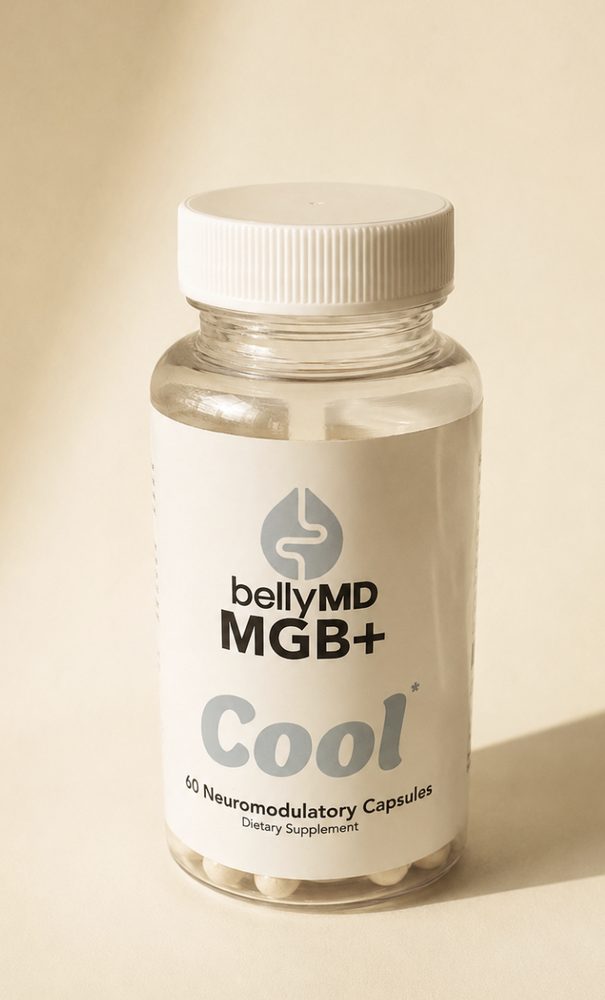
One bottle is a month. The protocol is three, and the 12-week guarantee covers all three.
My guarantee: 12 weeks, your first order, up to three bottles. Not helping? One email and it's refunded. Keep the bottles.
New customers: $119 today, then $129 every 90 days.
The $10 new-customer discount is applied for you at checkout. Free shipping. Subscriptions renew automatically at the price shown until you cancel; skip or cancel anytime.
"I noticed such a significant change and calmness in the gut, I recommended it to family."
For adults whose upper-belly burn, pressure and fullness track with stress and late meals. Not for pregnancy or nursing. Ask your clinician first if you take a blood thinner or live with kidney disease.
Cool is not an antacid and does not replace a prescription. Trouble swallowing, vomiting blood, black stools, weight loss, or chest pain with exertion is a doctor visit today, not an order.
Why do antacids wear off so fast?
They neutralize acid that is already there. If the stomach is stiff and overfull, the pressure that pushes it up builds again.
Can I take it with my acid reducer?
Yes, for most people. Cool contains no acid blocker and does not replace one. Keep taking what your clinician prescribed and bring the label to your next visit.
I take amitriptyline or nortriptyline for my gut. Should I stop?
No. Nothing on this page says stop. In the trial the drug was no more dangerous than placebo; it was not more effective. Keep taking what your clinician prescribed, ask for a whole-blood thiamine level at your next visit, and bring the Cool label. The fat-soluble form of B1 in Cool does not use the transporter these drugs block.
Why B1 for a stomach problem?
The stomach's exit is timed by muscle and nerve cells that use B1 to make energy. Several common prescriptions, metformin and some antidepressants among them, interfere with how the gut absorbs ordinary thiamine. That is one reason Cool uses the fat-soluble form.
Is the licorice safe for blood pressure?
Cool uses DGL, licorice with the glycyrrhizin removed. Glycyrrhizin is the compound that raises blood pressure.
How does the guarantee work?
Twelve weeks from delivery. If Cool is not helping, email support@belly-md.com and your first order is refunded, up to three bottles. You keep the bottles. One refund per household.
You've been treating what comes out the top. Start with the door.
Software needs power. The door runs on B1.
Start the 90-day protocolThis is an advertisement for MGB+ Cool, a dietary supplement made by BellyMD. Dr. Pescatore is the founder of BellyMD. The 2005 study cited measured the effect of induced anxiety on stomach function in healthy volunteers, and the 1985 study measured how stomach stretch affects the valve; neither tested MGB+ Cool or any supplement. The 2026 nortriptyline trial and the 2020 transporter study did not test MGB+ Cool or any supplement either; the transporter findings are laboratory and medical-record data, not a trial of vitamin B1 in indigestion. *These statements have not been evaluated by the Food and Drug Administration. This product is not intended to diagnose, treat, cure, or prevent any disease. Individual experiences vary. Consult your clinician before starting any supplement, especially if you are pregnant, nursing, taking medication, or living with a medical condition.