 A checklist from an emergency physician
Ask for a magnesium level. Here is what to say.
It is not on the standard blood panel, so most people have never had it checked. Five sentences for the appointment, the signs worth mentioning, and which form to start with if you need one.
 Rick Pescatore, DOBoard-certified emergency physician
"Please add a magnesium level to my blood work."
It is not part of the basic or comprehensive metabolic panel, so it has to be ordered on its own. Same needle, same draw.
Magnesium, serumBring your medication list.
Water pills and acid reducers taken every day are two of the most common reasons magnesium runs low. Say which ones you take and for how long.
Say the symptoms out loud.
Cramps, twitching, tingling, tiredness that sleep does not fix, nausea, a heart that skips or races. Use the check below to pick yours.
"What is my actual number?"
Most labs only flag a result below about 1.7 mg/dL. Researchers now recommend treating anything under about 2.07 mg/dL as low. Ask where you sit, not only whether it was flagged.
"If I need a supplement, which form and how much?"
The forms sit very differently with the gut, and kidney disease changes the answer. The guide below is a starting point for that conversation.
Tap what sounds like you.
These are common and have many causes. They are reasons to ask for the test, not proof of anything. Low magnesium often causes no symptoms at all.
Low magnesium is common, it is often silent, and it is not on the panel most people get. Separately, a national survey published this year found that more than two in three American adults fall below the cutoff researchers now recommend.
Read the study notes
Singer DD, Zhang Z, Peacock WF, Singer AJ. American Journal of Emergency Medicine 2026;110:349-354. Adult emergency patients from January to December 2025 with a serum magnesium drawn; low was 1.6 mg/dL or under (13.2%). After propensity matching for age, sex, race, ethnicity and comorbidities, 30-day mortality was 3.24% vs 1.91% (odds ratio 1.72). Arrhythmia, including torsades, ventricular tachycardia or fibrillation and QT prolongation, was 1.58% vs 1.12% and rose with severity. Observational: it shows a strong association, not that low magnesium alone caused the deaths, and it did not test supplements.
Jiao K, Costello R, Gahche J, Rosanoff A, Wallace TC. Journal of Nutrition 2026. NHANES 2021 to 2023, 5,474 adults: 67.8% had serum magnesium below 2.06 mg/dL (0.85 mmol/L), the lower limit an expert group recommended in 2022. Most labs have not adopted it.
The usual reasons.
- Water pills (diuretics)flush it out in urine
- Acid reducers taken daily for a year or moreFDA warning since 2011
- Diabeteslost in urine when sugar runs high
- Drinking most daysless absorbed, more lost
- Chronic diarrhea, Crohn's or celiac diseasenot absorbed
- Older ageabsorb less, lose more
The form matters more than the brand.
| Form | What to know |
|---|---|
| Glycinate | Where most people should start. Absorbs well and is gentle on the stomach. |
| Taurate | Increasingly recommended for palpitations. A heart that skips or races needs an EKG first, then the supplement conversation. |
| Malate | Often chosen for muscle aches. Less research behind it than glycinate. |
| Threonate | Studied for sleep and memory in small trials funded by its maker. |
| Oxide | Cheapest and common in multivitamins. Poorly absorbed, and the most likely to act as a laxative. |
How much. Unless your doctor sets a dose, stay at or under 350 mg a day of magnesium from supplements. The label lists the magnesium itself separately from the compound it is bound to.
Kidney disease. Do not start magnesium on your own. Kidneys clear it, and levels can climb too high.
Timing. Keep it a few hours away from tetracycline or quinolone antibiotics, osteoporosis pills, and thyroid medicine. It binds them.
Take it into the room.
Page one is the five asks and the forms. Page two is written for your doctor: the study, the citation, and what it does not prove.
One email with the PDF. No product pitch inside it. Leave the list in one click.
One more thing, only if you want it: I write when a study is worth your time, and now and then about what I make at BellyMD.
Walk in with a record, not a memory.
Bring the paper, not just the question.
When the level is fine and the mornings are not.
Plenty of people get the test, come back normal, and still wake up queasy and wired. That pattern is a signal problem between the gut and the brain, and it is what I built Calm around.
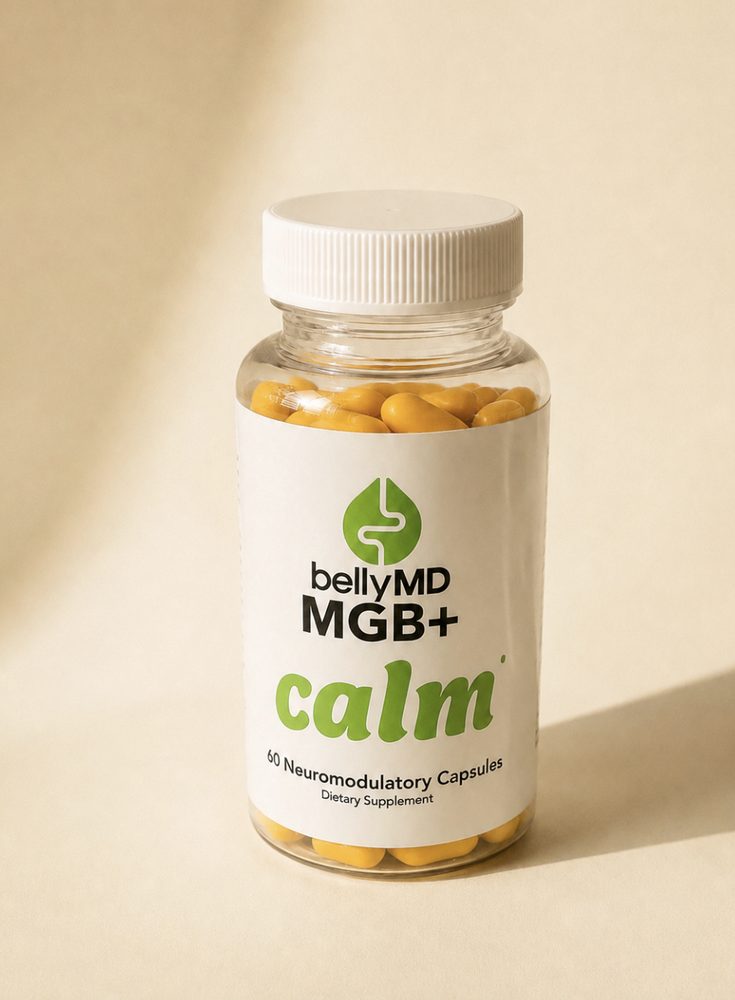
MGB+ Calm. Six actives. Beta-caryophyllene from black pepper and cloves leads. Benfotiamine, a well-absorbed B1, and magnesium glycinate feed the nerve. Ginger settles. Every dose on the label. Twelve-week guarantee.
Is Calm a magnesium supplement?
Not in the sense this page means. It contains magnesium glycinate as one of six actives, at a daily-support amount. It is not built or dosed to correct a low level. A low level gets treated the way your doctor directs.
My level came back normal. Should I still take magnesium?
Ask where in the range you sit. If you are near the bottom, have one of the risks above, or have symptoms, it is a reasonable conversation. If you are comfortably in range, a supplement may add little.
What about the red blood cell magnesium test?
It is sold widely online. Serum magnesium is the standard test and the one the studies on this page used. Start there.
The product section of this page is an advertisement for MGB+ Calm, a dietary supplement made by BellyMD. Dr. Pescatore is the founder of BellyMD. The studies described above did not test MGB+ Calm or any supplement. The form guide is general information, not a recommendation for any individual. These statements have not been evaluated by the Food and Drug Administration. This product is not intended to diagnose, treat, cure, or prevent any disease. Consult your clinician before starting any supplement, especially if you have kidney disease, are pregnant or nursing, or take medication.