
Functional dyspepsia: the forgotten diagnosis.
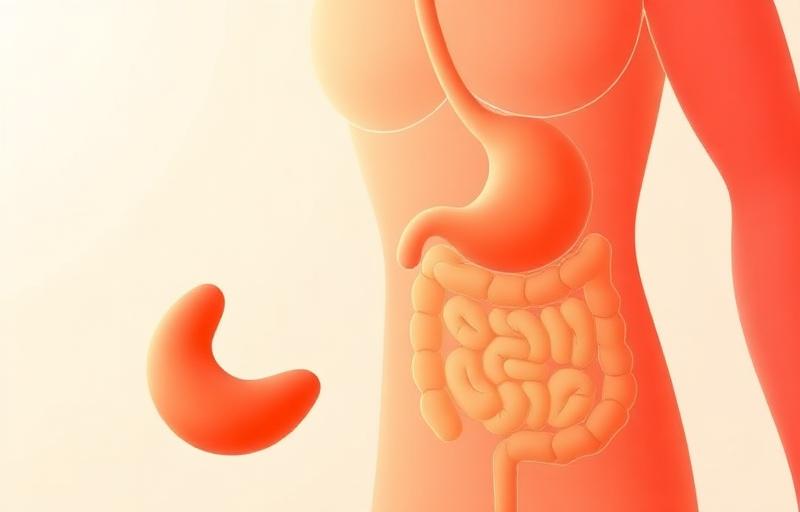
Millions of adults walk around with burning, fullness, or pain in the upper stomach. Their scopes come back normal. The diagnosis usually never gets made.
Functional dyspepsia (FD) is the most under-recognized disorder of gut-brain interaction (DGBI) in primary care. Up to 7 percent of adults qualify under the current Rome criteria. Almost none of them know the name. They get told it is reflux, or stress, or anxiety. Then they get a proton-pump inhibitor (PPI) and sent on their way.
There is a real condition under the label. It has a definition, subtypes, mechanisms, and treatments with actual evidence. It is worth naming.
What functional dyspepsia actually is
The Rome criteria define FD as one or more of four upper-gut symptoms with no structural disease on workup. The four symptoms are early satiety (feeling full after only a few bites), postprandial fullness (heavy bloating after a normal meal), epigastric pain, and epigastric burning. Symptoms have to be present for at least three months, with onset six months earlier, and bothersome enough to affect daily life.
The workup is what makes it functional. An upper endoscopy looks at the stomach lining and the first part of the small intestine. Bloodwork rules out H. pylori, anemia, and metabolic causes. When the standard search comes back clean and the symptoms persist, FD is what is left.
Functional does not mean imaginary. It means the problem is in how the gut works, not in what the gut looks like. Those are different questions, and the answer to the first one is where most of the medical system stops looking.
The two subtypes, in plain English
FD splits into two clinical patterns. Most people sit mostly in one.
Postprandial distress syndrome (PDS) is the meal-related pattern. The trigger is eating. Symptoms are early satiety and postprandial fullness, sometimes with nausea and upper bloating. People with PDS often say they cannot finish a normal-size meal.
Epigastric pain syndrome (EPS) is the pain-and-burning pattern. The trigger is less tied to meals. Symptoms are bouts of pain or burning in the upper middle of the abdomen, sometimes between meals, sometimes at night. This is the pattern that gets misread as reflux most often.
The two patterns overlap in roughly a third of patients. Stanghellini and colleagues, who chaired the Rome IV update on gastroduodenal disorders, argued the subtypes still matter because they predict which treatments are most likely to help (Stanghellini 2016). PDS responds better to prokinetics. EPS responds better to neuromodulators.
Why FD gets missed
Four forces conspire to bury the diagnosis.
First, GERD overlap. Acid reflux and FD share epigastric burning as a symptom. The reflexive read is that burning above the belly button means acid, and acid means a PPI. A trial of acid suppression often becomes the entire workup. When the PPI does not fully work, the assumption is that the dose is wrong, not the diagnosis.
Second, the anxiety label. Patients who present repeatedly with upper-gut symptoms and normal testing get reframed as anxious. Stress modulates symptoms, so the framing is not wholly wrong. It is incomplete. Calling it anxiety and stopping there skips the named diagnosis that explains why the symptoms are anchored in the upper stomach in the first place.
Third, the PPI default. PPIs help a meaningful minority of FD patients, especially EPS-pattern burning. They do nothing useful for accommodation failure or visceral hypersensitivity, which drive the rest of the condition.
Fourth, no visible pathology. Modern medicine is built around what imaging and endoscopy can see. FD lives below that resolution. A clean scope is where the real diagnostic thinking should start, not where it should end.
What is actually happening in the upper stomach
Four mechanisms recur in the FD literature. Most patients have some mix.
Delayed accommodation. After a meal, the upper part of the stomach is supposed to relax and expand to make room for food. In many FD patients, that relaxation is sluggish. Food piles up against tight muscle, and the brain reads that as fullness, pressure, or pain after only a few bites. This is the leading mechanism in PDS.
Visceral hypersensitivity. The nerves that monitor stretch and chemical change in the stomach are turned up too high. Normal stomach activity gets interpreted by the brain as discomfort. This pattern shows up in EPS more than PDS.
Low-grade duodenal inflammation. The most interesting development of the past decade is the consistent finding that many FD patients have subtle inflammation in the duodenum. Talley and colleagues at Newcastle have shown that duodenal eosinophil counts are elevated in a large subset of FD patients compared to healthy controls (Talley 2007, Walker 2014). It is not visible to the naked eye on endoscopy. It shows up under the microscope, and it appears to feed visceral hypersensitivity upstream.
Disordered brain-gut signaling. The traffic between the central nervous system and the enteric nervous system is dysregulated in FD. Stress, sleep, mood, and central pain processing all feed back into how the stomach behaves. This is why neuromodulators help.
Treatments with evidence
The treatment list is broader than the PPI most people get handed.
Prokinetics. Drugs that speed gastric emptying and improve accommodation help PDS most. Itopride, acotiamide, and mosapride have positive trial data, though availability varies by country.
Neuromodulators. Low-dose tricyclic antidepressants, especially amitriptyline at doses well below those used for depression, modulate visceral hypersensitivity and central pain processing. Talley and colleagues ran the FUNCTION trial showing amitriptyline at 50 mg outperformed placebo for EPS-predominant FD (Talley 2015). The mechanism is pain-pathway modulation, not mood treatment.
Mastic gum. Resin from the Pistacia lentiscus tree, used in the eastern Mediterranean for upper-gut symptoms for centuries. Dabos and colleagues randomized 148 FD patients to mastic gum or placebo for three weeks and found significant improvement in dyspepsia symptom scores (Dabos 2010).
Ginger. Gastric emptying is delayed in many PDS patients. Hu and colleagues showed that 1.2 grams of ginger improved gastric emptying and reduced postprandial fullness (Hu 2011). In the right patient, it moves the dial.
Zinc-carnosine. A chelated compound used in Japan for decades to support gastric mucosal integrity. Trial data in FD and gastritis show improved symptom scores and direct mucosal support, distinct from acid suppression.
Gut-directed hypnotherapy. A structured protocol aimed at the gut-brain axis, delivered by trained clinicians. The evidence base is strongest in IBS but extends into FD. The effect sizes in trials are not small.
When acid blockers help and when they do not
PPIs are not useless in FD. They help a real subset of patients, mostly EPS pattern with burning as a dominant feature, mostly in the first weeks. The number-needed-to-treat is modest but real.
Where PPIs fail is everything else. They do nothing for accommodation. They do nothing for visceral hypersensitivity. They do nothing for duodenal eosinophilia. In PDS, the upper-gut fullness pattern, PPIs are largely a wash. Long-term use carries its own costs: nutrient malabsorption, altered upper-gut microbiome, and rebound acid hypersecretion when discontinued.
The frame is simple. A short trial of acid suppression is reasonable when burning is dominant. If symptoms do not clearly improve in four to eight weeks, the answer is not a higher dose. The answer is a different mechanism and a treatment aimed at it.
What to do
- Ask for the name. If you have upper-gut symptoms with a normal scope, ask whether functional dyspepsia is on the list and whether you fit PDS or EPS. The label changes what to try next.
- Track the pattern for 30 days. Note what you ate, how full you felt, when burning happened, and how meals timed with symptoms. PDS and EPS show themselves in the data.
- Audit your PPI. If you have been on acid suppression for months without clear benefit, that is information. A different mechanism likely fits the picture better.
- Treat the gut-brain axis as a real system. Sleep, stress load, and meal structure all change FD symptoms. They are part of the treatment, not adjuncts to it.
- Find a clinician who knows the literature. A gastroenterologist familiar with DGBI and the Rome framework is worth the visit.
FD is a named, treatable pattern. The fact that most people never hear the name is the failure, not the diagnosis.