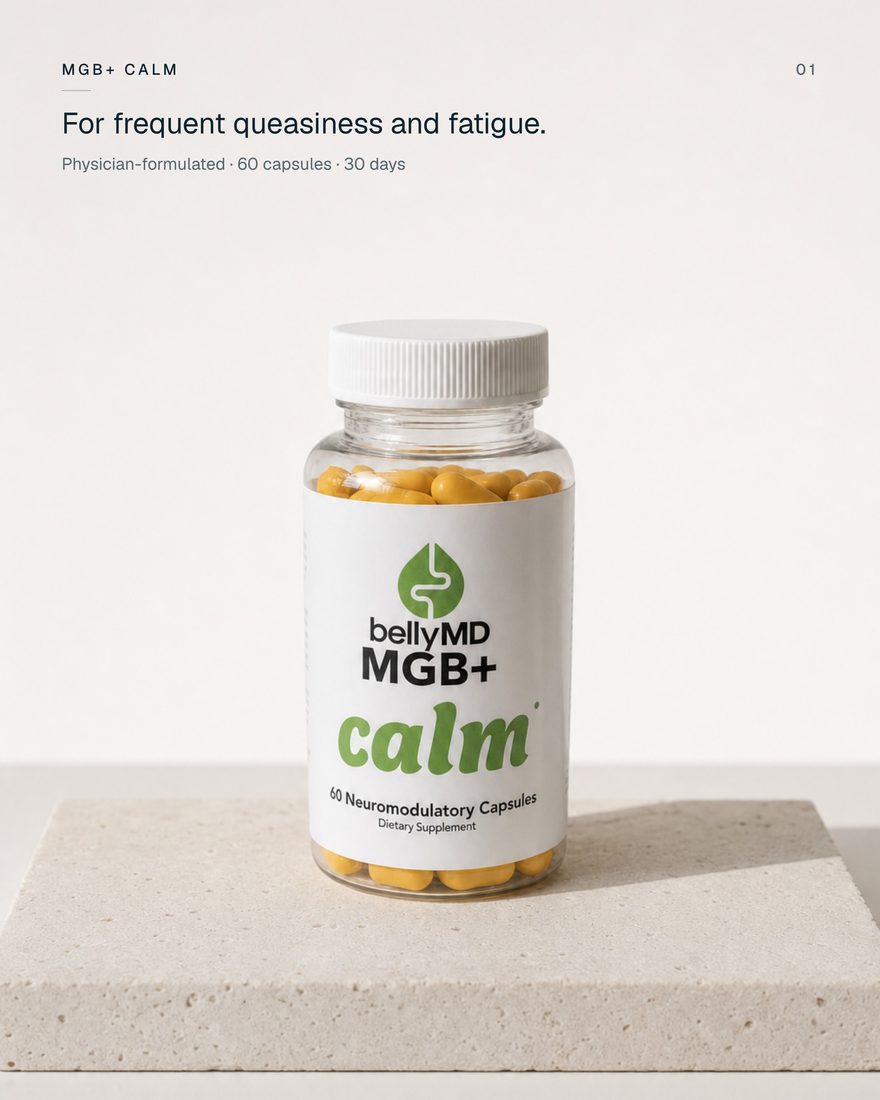
MGB+ Calm
For queasiness and fatigue.
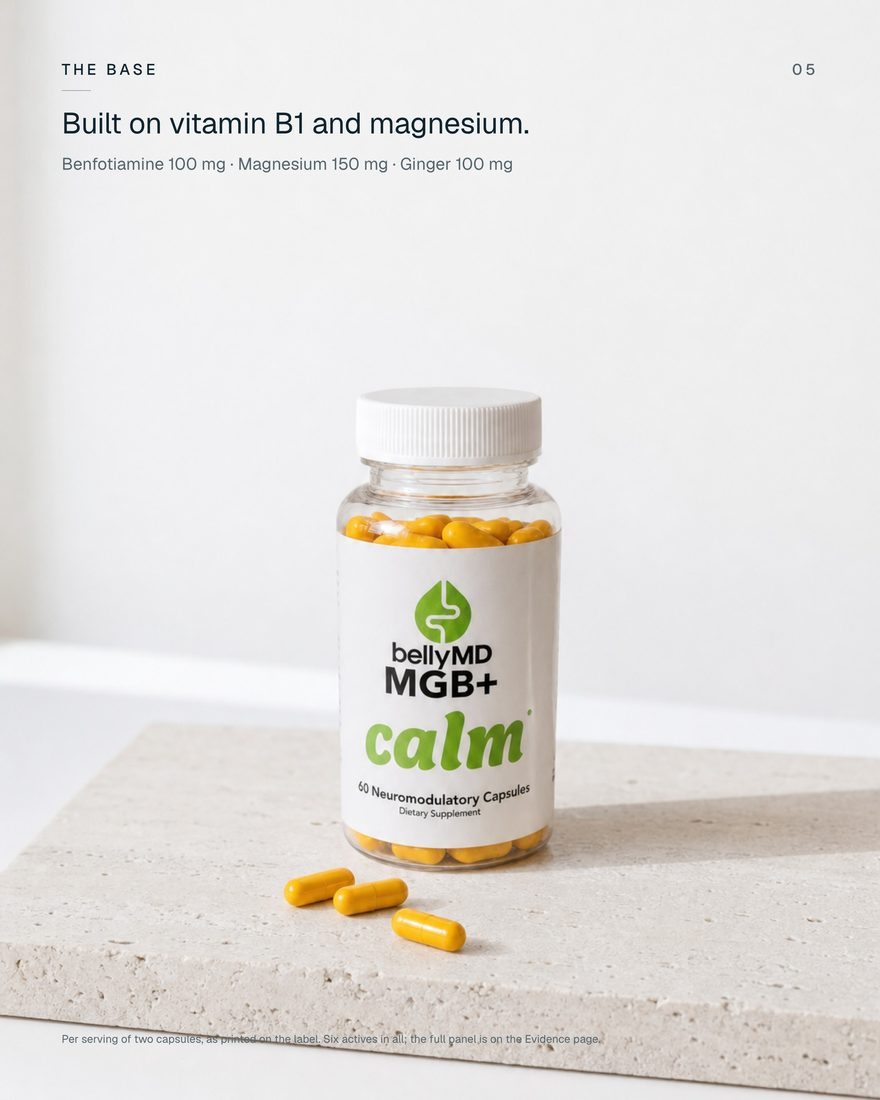
Six actives, including a base of vitamin B1 and magnesium, led by beta-caryophyllene. Two capsules a day, with food.
From $43 a bottle·12-week money-back guarantee
Mostly bloating and brain fog? That is Clear. Mostly burning or reflux? That is Cool.
Three bottles today, then every 90 days. We email you a week before each shipment. Cancel from your account or by email.
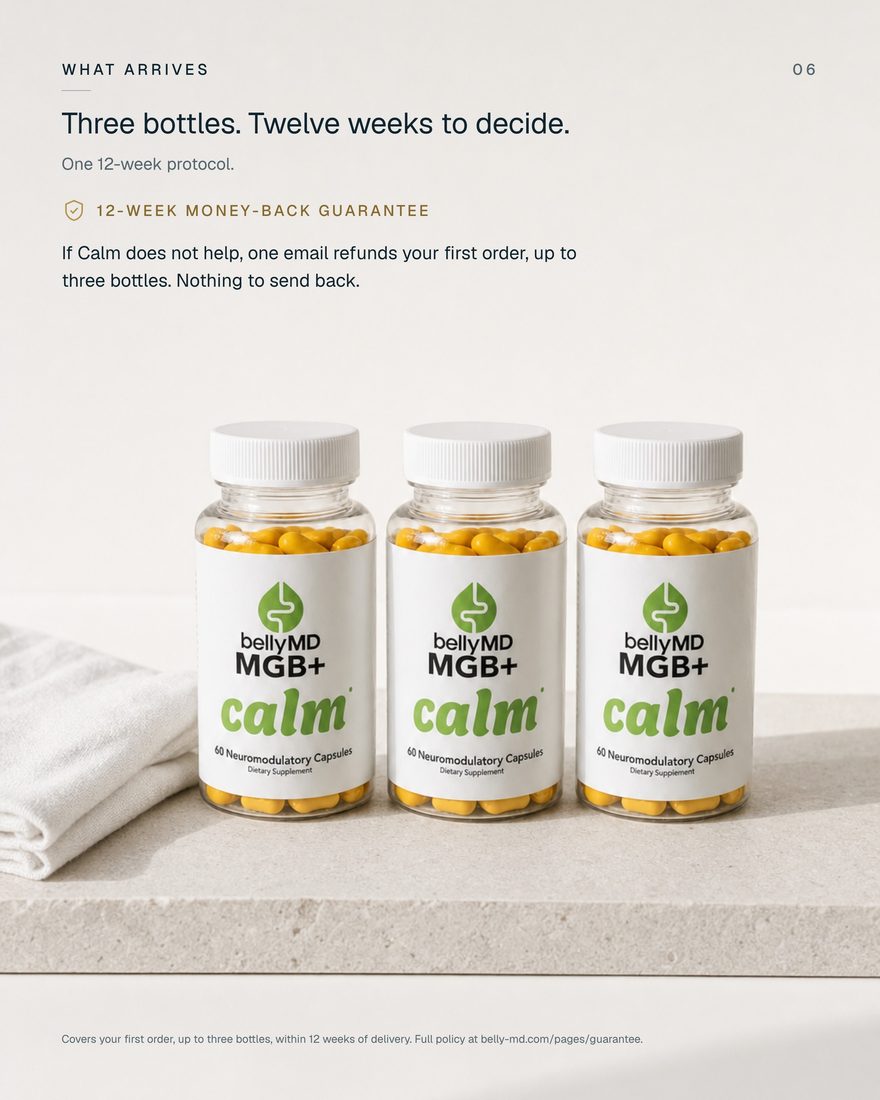
Covers all three bottles of your first order. Write to us within 12 weeks of delivery for a full refund, and keep whatever is left. Read the policy
- Acid reducers (omeprazole, pantoprazole, famotidine). Keep taking your prescription; this is not a replacement for it. Long-term acid reducers can lower magnesium, which is one reason magnesium is in the base.
- Statins. We found no documented interaction with these ingredients.
- Antidepressants. Sertraline and several other antidepressants block the transporter that carries vitamin B1 into cells, which raises the risk of thiamine deficiency. Calm also contains piperine (black pepper), which can slow how the body clears some medicines.
Not on this list is not clearance. Show the list to your pharmacist. Full precautions
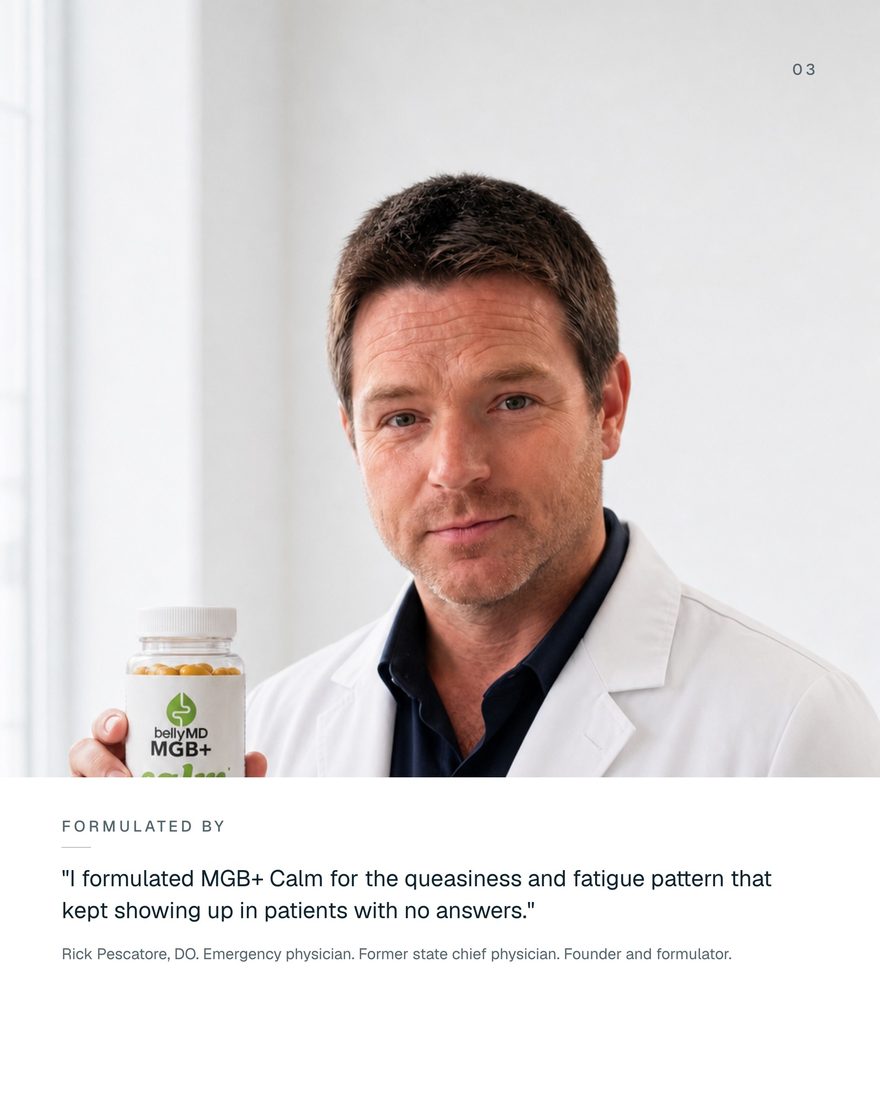
- Formulated by
- Rick Pescatore, DO →Emergency and public health physician
- Dosage
- Two capsulesOnce daily, with food
- Manufactured
- New YorkBottled and sealed in the USA
- Shipping
- Free3 to 7 business days, US
Is this me?
A daily capsule for adults. Two capsules with food, once a day.
- Queasy mornings
- Nausea that comes and goes on its own schedule
- Flat and tired after the queasiness
Bloating and brain fog are the main problem: that is Clear. Burning, reflux or urgency: that is Cool.
Under 18. Pregnancy or breastfeeding, unless your clinician says otherwise.
Vomiting blood, weight loss you did not intend, severe pain, or vomiting you cannot stop or keep fluids down through. Those need a doctor the same day, not a supplement.
Why vitamin B1
Vitamin B1 is what your cells use to turn food into energy. Your nerves and your gut wall burn through it fastest.
Calm uses benfotiamine, a form of B1 with thirty years of research of its own. It is absorbed several times better than the ordinary kind.
Glycinate, the gentle form, at 150 mg, the highest dose in the line.
What is inside
Three actives are only in Calm.
Plus the base every formula shares: vitamin B1, magnesium glycinate and ginger.
See all six ingredients, the amounts, and what each one does
How to take it
- Two capsulesonce a day
- With a mealit helps absorption, and usually the queasiness
- Judge it at week 4 to 12the refund window covers the whole course
Taking it with Clear or Cool? One capsule of each, once a day, not a full serving of both.
Precautions and interactions
Supplements can interact with medicines. Read this first. Not being on this list does not mean cleared: if you take anything daily, show this page to your pharmacist.
The common ones
- Acid reducers (omeprazole, pantoprazole, famotidine). Keep taking your prescription; this is not a replacement for it. Long-term acid reducers can lower magnesium, which is one reason magnesium is in the base.
- Statins. We found no documented interaction with these ingredients.
- Antidepressants. Sertraline and several other antidepressants block the transporter that carries vitamin B1 into cells, which raises the risk of thiamine deficiency. Calm also contains piperine (black pepper), which can slow how the body clears some medicines.
Ask your clinician first if you take
- Any prescription medicine at all, if the dose matters. Piperine slows the enzymes that clear many drugs from the body, which can push their levels up. That is exactly why it is in the formula, and it does not distinguish between curcumin and a prescription. Bring this page to whoever manages your medicines.
- Blood thinners or antiplatelet medicines. Both turmeric and ginger have mild antiplatelet activity.
- Gallstones or a blocked bile duct. Turmeric stimulates bile flow.
- Thyroid medicine. Magnesium binds levothyroxine and lowers how much of it you absorb. Leave four hours between your thyroid dose and Calm.
- Anything for kidney disease. Magnesium is cleared by the kidneys.
Do not take
- If you are pregnant or breastfeeding, unless your clinician has said otherwise. Ginger at supplement doses in pregnancy is a decision for your own doctor.
- If you are under 18.
- If you have reacted to any ingredient in section 3.
Stop and get advice if
- Vomiting that you cannot stop, or that stops you keeping fluids down. That is a same-day problem for a clinician.
- You feel lightheaded standing up, or your blood pressure drops.
- You develop a rash, swelling or difficulty breathing. That is an emergency, not a support email.
- Anything new starts and does not settle. Write to support@belly-md.com and we will help you work out whether it is the formula.
Evidence
Every ingredient has a printed brief of the published research, written so you can hand it to your own doctor. Every citation was checked against the source.
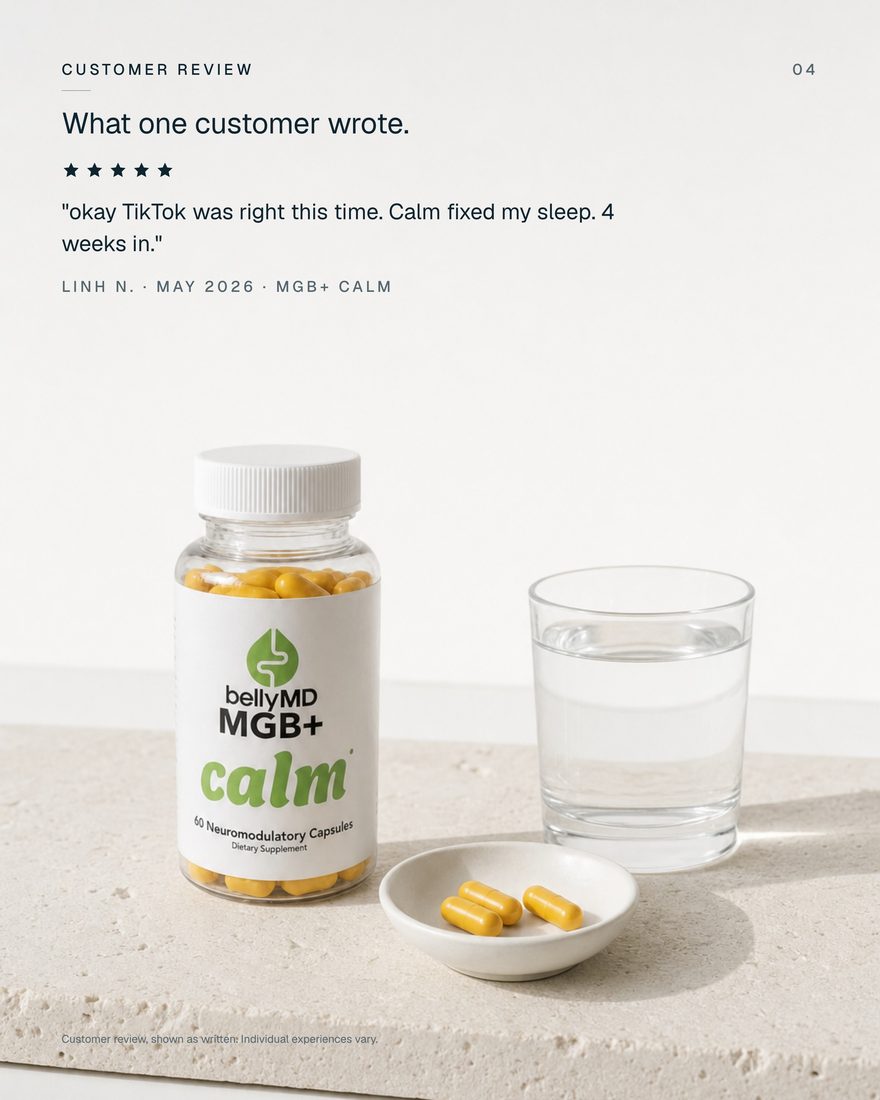
“I was struggling with morning nausea and this really settled my stomach.”
Robert Brown · December 2025 · MGB+ Calm
84% of 204 customers surveyed in May 2026 said they would order again. Self-reported, not a clinical outcome. Individual experiences differ and results are not guaranteed.
“I’ve been suffering with CHS for years and I completely had to quit for three years because my health was getting so bad but I think this might be the solution. I’ve been taking these supplements every day and I heard after two weeks the progress really starts to show.”
Connor Bogdan · July 2026 · MGB+ Calm · Verified buyer
Reviews come from verified purchases. Nothing here is a claim that the formula treats a diagnosed condition.
Who checked it
MGB+ Calm was formulated by Rick Pescatore, DO, an emergency and public health physician. Four independent reviewers checked the framework behind the line: Dr. Niforatos (Cleveland Clinic), Dr. Motov (Maimonides Medical Center), Dr. Reeves (Brooke Army Medical Center) and S. Enright, M.Ed. None is paid.
Questions
Which of the three formulas is mine?
Match the pattern. Clear is bloating and brain fog. Cool is burning and bubbling. Calm is queasiness and fatigue. If two sound like you, the two-minute quiz will sort it.
Why is there black pepper in it?
Because turmeric on its own barely gets into your blood. Black pepper slows the step that clears it, so a small dose of turmeric works like a bigger one. Section 2 has the picture. The same property is why section 5 asks about your prescriptions.
Can I take it with my other medicines?
Usually, but not always. Section 5 lists what to check first. If anything on that list is yours, ask your clinician before you start. We would rather lose a sale than get that wrong.
What happens if it does not work?
Email support@belly-md.com within 12 weeks of delivery. Full refund on your first order, up to three bottles, and you keep what is left. Or swap to a different formula for free.
Do I have to subscribe?
No. One bottle, one time, is on the buy panel above. The subscription costs less because a formula like this is judged over months, not days. Skip, swap or cancel any time.
The other two formulas
Twelve weeks, or your money back
Three bottles, $129, shipped free. If it does nothing for you, write to us and keep what is left.
Queasiness · Mornings · Fatigue
MGB+ Calm
The steadier morning
When your stomach decides how the day is going to go.
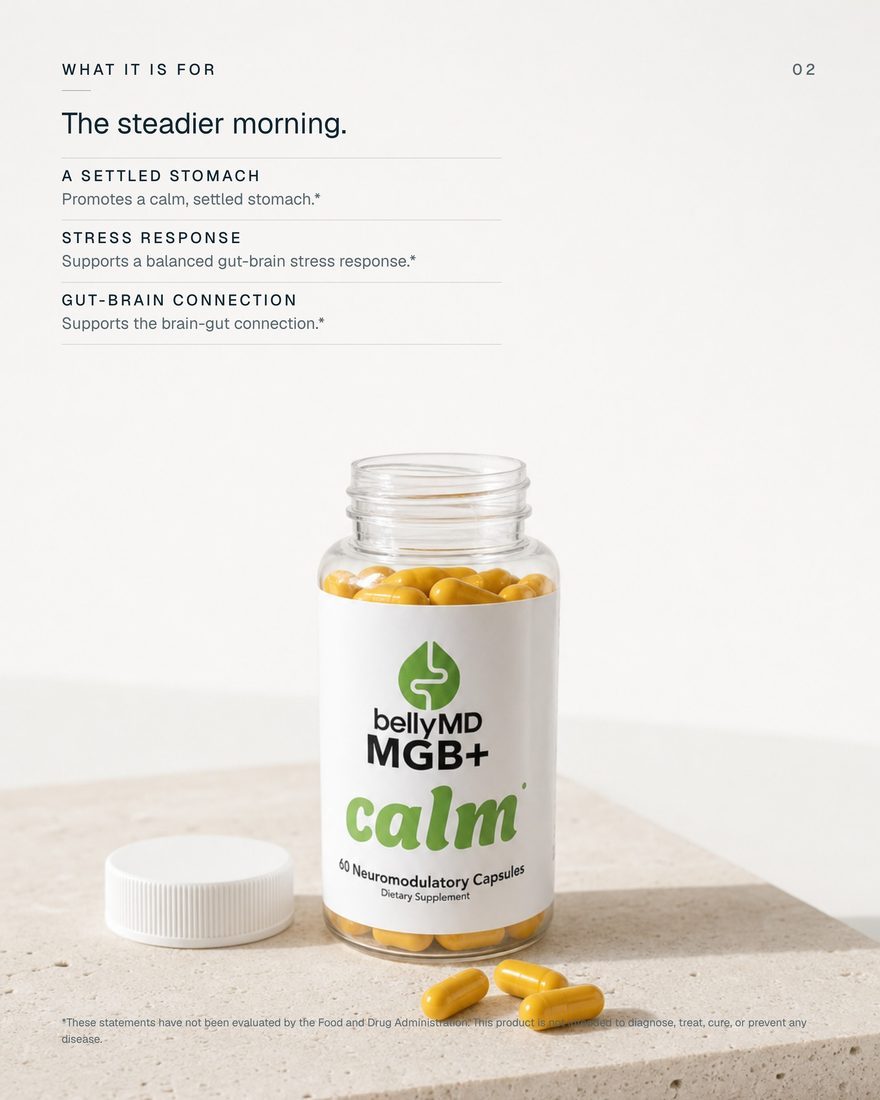
What it does- Helps settle morning nausea and queasiness
- Promotes a calm, settled stomach
- Supports a balanced gut-brain stress response
- Supports the brain-gut connection
Six active ingredients. Three of them only in Calm.
Beta-caryophyllene is a terpene from black pepper, cloves and copaiba, and it speaks directly to the immune cells of the gut wall. It is the reason Calm leads with a spice rack rather than with a mineral.
Two capsules daily, with food
Four to twelve weeks
What is inside
Unique to Calm- Beta-caryophyllene black pepper, cloves, copaiba
- 100 mg
- The lead ingredient. Binds a receptor on the immune cells of the gut wall, with no effect on the mind.
- Turmeric root 95% curcuminoids
- 80 mg
- Curcumin at 95 percent, the most studied botanical for the inflammatory response.
- Piperine 95% piperine
- 5 mg
- Raises curcumin absorption twentyfold. Slows some medicines the same way: see the precautions.
- Benfotiamine a derivative of B1
- 100 mg
- Thirty years of clinical literature. Absorbed several times better than ordinary thiamine.
- Magnesium as glycinate
- 150 mg
- The highest magnesium dose in the line, bound to the calming amino acid.
- Ginger root 4:1
- 100 mg
- The best-studied botanical for nausea, full stop.
MGB+ Calm
12-week protocol · 3 bottles