 Advertisement
Updated October 12, 2026
On an acid reducer? Ask for these two levels.
Four of the most common acid reducers were flagged this year in the FDA's own side-effect database for vitamin B1 deficiency. The likely link is a magnesium warning the FDA issued in 2011. Ten-second check below, then the exact words for your doctor.
 Rick Pescatore, DOBoard-certified emergency physician. Former Chief Physician, Delaware Division of Public Health. Editor-in-Chief, Emergency Medicine News.
Step 1. Tap the pills you take.
Step 2. How long on the acid reducer?
"Please order a serum magnesium level."
It is not on the standard panel. It gets added only when someone asks. Results the same day as the rest of your blood work.
Magnesium, serum"Please order a whole blood thiamine level."
Whole blood measures the active form inside red cells and is the standard test. It is a send-out, about a week, so ask early. If plasma thiamine is offered as well, take both.
Vitamin B1 (thiamine), whole bloodTwo facts, fifteen years apart. They are the same fact.
Prescription acid reducers taken long term can cause low magnesium. Most of the cases the FDA reviewed came after more than a year of use. In about a quarter of them, magnesium supplements alone did not fix it and the pill had to be stopped.
The warning has been in the prescribing information of every drug in the class since. Few patients have read it.
Twenty years of side-effect reports, 1,046 cases of vitamin B1 deficiency, 46 percent hospitalized. Four acid reducers cleared every one of the study's four signal tests.
A signal means B1 deficiency was reported with these drugs far more often than expected. It is a flag, not a verdict.
The one study that measured B1 in people on these pills. Five hundred adults in Kashmir, India. Twenty-eight percent of acid-reducer users had low thiamine, against nineteen percent of everyone else, after adjusting for diet.
One study, one region. Nobody has measured this in the United States.
I am not telling anyone to stop an acid reducer. Stopping cold can hurt you. I am telling you what to check.
Read the study notes
- Rotterdam cohort, 9,818 adults (Kieboom, Am J Kidney Dis 2015): acid-reducer users twice as likely to be low in magnesium; three times after prolonged use; seven times with a loop diuretic on top. H2 blockers such as famotidine also doubled the odds.
- Case series (Hess, Aliment Pharmacol Ther 2012): median onset 5.5 years into treatment; magnesium recovered within four days of stopping and fell again within four days of restarting.
- Pooled observational data, 131,507 patients (Medicine 2019): 19.4 percent of users low in magnesium versus 13.5 percent of non-users; adjusted odds 1.71; higher doses, higher odds.
- The FAERS flag (Du, JPEN 2026): reports are voluntary and unverified. People on long-term acid reducers are often older, sicker, or on other medicines on the same list, so the drug cannot be separated from the patient. The authors say this themselves. Esomeprazole and the H2 blockers did not signal.
- Kashmir (Nutr Res 2026): adjusted odds 1.93, confidence interval 1.03 to 3.58. Borderline, and a rice-washing population with 18 percent low B1 overall.
- Why magnesium matters for B1: the enzyme that activates thiamine needs magnesium. Physicians have described Wernicke's encephalopathy that did not respond to B1 until magnesium was replaced (Traviesa, J Neurol Neurosurg Psychiatry 1974; Dyckner, Acta Med Scand 1985).
B1 does not work until magnesium switches it on.
The vitamin you swallow is not the form your nerves use. An enzyme has to convert it, and that enzyme runs on magnesium. Tap to see what changes.
Magnesium normal: the vitamin is converted and moves on to the nerves that run your gut.
So the daily capsule carries both.
Magnesium glycinate and a highly absorbed form of B1 in the same capsule, so the switch and the vitamin arrive together. Which one depends on why you take the acid reducer.

MGB+ Cool
Seven actives. Two capsules a day, with a meal.
Allithiamine, a fat-soluble B1, 150 mg, with magnesium glycinate, 100 mg, to support healthy nerve signaling.*
Chios mastic, 500 mg, with zinc carnosine, DGL licorice and aloe inner gel to support a healthy stomach lining.*
Ginger root extract to support comfortable digestion after eating.*
See every dose
| Mastic gumResin of Pistacia lentiscus. | 500 mg |
| AllithiamineA fat-soluble form of vitamin B1. | 150 mg |
| MagnesiumAs magnesium glycinate. | 100 mg |
| Ginger root extract, 4:1 | 100 mg |
| Aloe vera200:1 inner gel extract. | 100 mg |
| DGL licorice extractGlycyrrhizin removed, the part that raises blood pressure. | 80 mg |
| ZincAs zinc L-carnosine. | 5 mg |
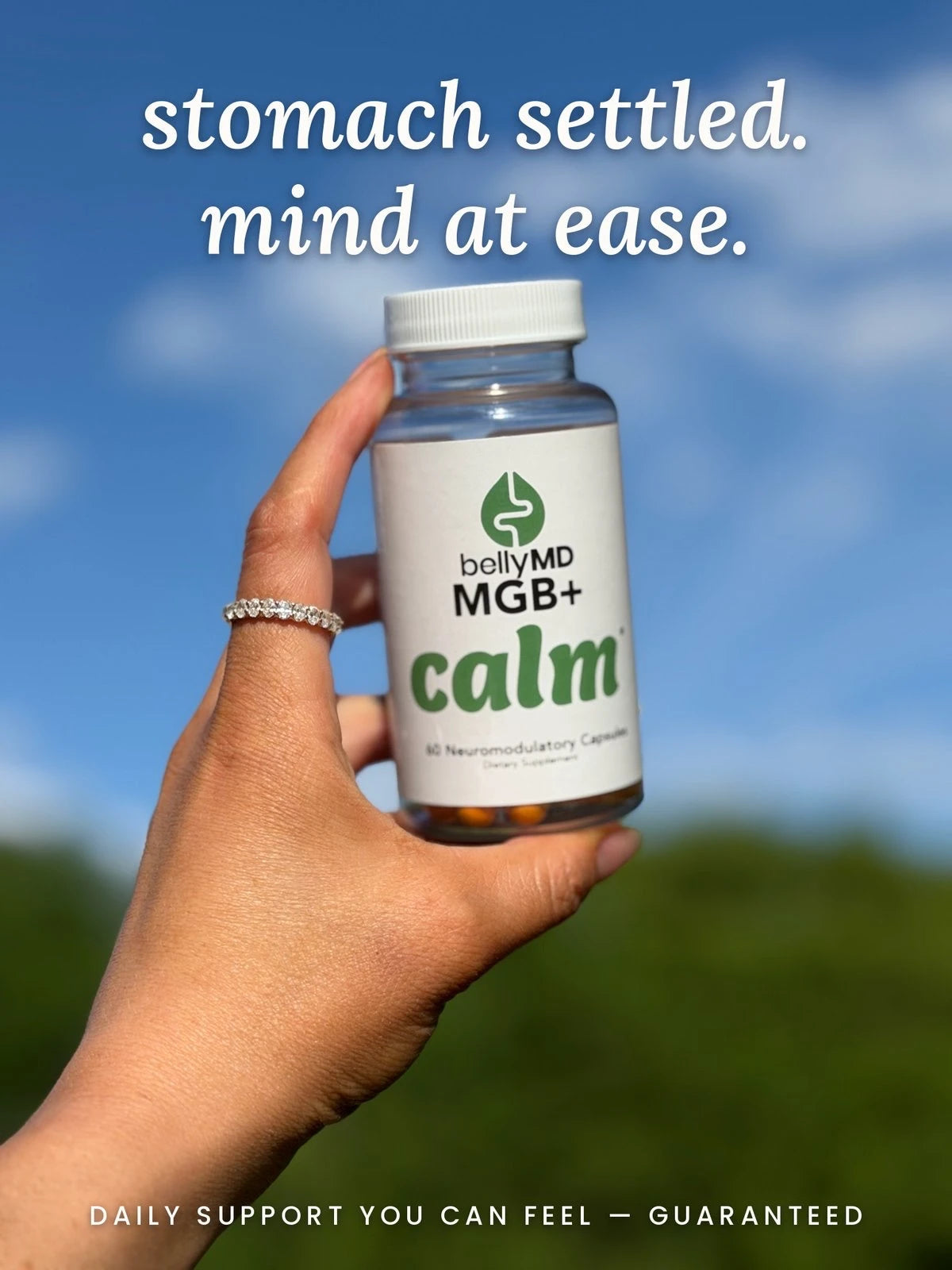
MGB+ Calm
Six actives. Two capsules a day, with a meal.
Benfotiamine, a highly absorbed form of B1, 100 mg, with magnesium glycinate, 150 mg, to support healthy nerve signaling.*
Beta-caryophyllene, a terpene found in black pepper, cloves and copaiba, with ginger root to support a settled stomach.*
Curcumin, with piperine so it absorbs.*
See every dose
| MagnesiumAs magnesium glycinate. | 150 mg |
| BenfotiamineA highly absorbed form of vitamin B1. | 100 mg |
| Beta-caryophyllene | 100 mg |
| Ginger root extract | 100 mg |
| Curcumin | 80 mg |
| PiperineSo the curcumin absorbs. | 5 mg |
One bottle is a month. The protocol is three, and the 12-week guarantee covers all three.
My guarantee: 12 weeks, your first order, up to three bottles. Not helping? One email and it's refunded. Keep the bottles.
New customers: $119 today, then $129 every 90 days.
The $10 new-customer discount is applied for you at checkout. Free shipping. Subscriptions renew automatically at the price shown until you cancel; skip or cancel anytime.
Take both asks into the room.
Page one is the two sentences, large type, with room for the date and the result. Page two is written for your doctor: the 2011 warning, the 2026 flag, the citations, and what they do not prove.
One email with the PDF. No product pitch inside it. Leave the list in one click.
One more thing, only if you want it: I write when a study is worth your time, and now and then about what I make at BellyMD.
For adults on a daily acid reducer whose tests come back normal and who want magnesium and B1 in one place while they wait for the appointment. Not for pregnancy or nursing. If you live with kidney disease, ask your clinician before any magnesium. Magnesium can bind certain antibiotics and thyroid pills in the gut; take those two hours apart.
Keep taking what your clinician prescribed. Neither capsule is an acid blocker and neither replaces one. New confusion, unsteadiness, double vision, or weeks of vomiting is an emergency visit, not a supplement. Trouble swallowing, vomiting blood, black stools, or weight loss is a doctor visit this week.
Should I stop my acid reducer?
No. Not from a web page. Stopping cold brings the acid back harder, and for some people the pill is protecting an ulcer or a damaged esophagus. Ask for the two levels. If one is low, your prescriber decides what changes.
What about Nexium or Pepcid?
Esomeprazole (Nexium) did not show a B1 signal in the 2026 analysis, and it carries the same 2011 magnesium warning as the rest of its class. Famotidine (Pepcid) was not flagged for B1 either, but in the Rotterdam cohort H2 blockers also doubled the odds of low magnesium. Switching is not a clean exit. Ask for the levels either way.
Is this capsule a treatment for low magnesium or low B1?
No. A low level is treated by your doctor, usually with prescription-dose thiamine and magnesium, and nothing here is dosed for that. These are daily formulas built around gut-brain signaling. The 2011 warning and the 2026 flag did not test MGB+ or any supplement.
Why not plain B1 tablets?
If your doctor is treating a diagnosed deficiency, do exactly that. For a daily capsule, the form matters: allithiamine and benfotiamine absorb far better than plain thiamine in head-to-head human studies, and both come paired here with the magnesium that switches B1 on.
Can I take it with my acid reducer?
Yes, for most people. Neither formula contains an acid blocker. Keep taking what was prescribed and bring the label to your next visit.
How does the guarantee work?
Twelve weeks from delivery. If it is not helping, email support@belly-md.com and your first order is refunded, up to three bottles. You keep the bottles. One refund per household.
The warning sat in the fine print for fifteen years. The two tests take one blood draw.
Start the 90-day protocolThe product section of this page is an advertisement for MGB+ Cool and MGB+ Calm, dietary supplements made by BellyMD. Dr. Pescatore is the founder of BellyMD. The FDA communication, the adverse-event analysis and the community study described above did not test MGB+ or any supplement, and a pharmacovigilance signal does not establish that a drug caused an outcome. *These statements have not been evaluated by the Food and Drug Administration. These products are not intended to diagnose, treat, cure, or prevent any disease. Consult your clinician before starting any supplement, and do not stop a prescribed medication without talking to the clinician who prescribed it.